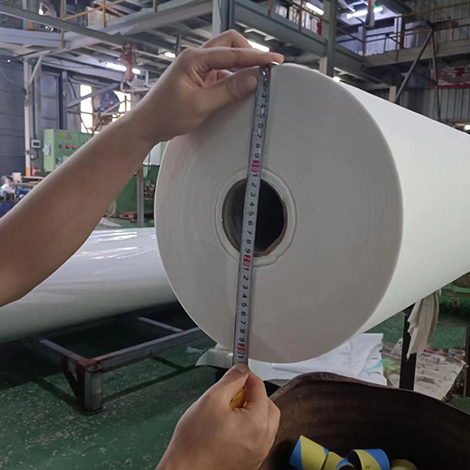

Aucun processus de fabrication n'est parfait. Même avec des lignes d'extrusion modernes et des contrôles de qualité stricts, tissu non tissé spunbond en polypropylène peut parfois présenter des défauts.
La différence entre un bon fournisseur et un excellent fournisseur ne réside pas dans l'apparition ou non de problèmes, mais la rapidité avec laquelle ils sont identifiés, compris et corrigés.
Dans cet article, nous allons parcourir les problèmes de qualité les plus courants dans les non-tissés spunbond en PP, quelles en sont les causes, et — surtout — comment les résoudre.
Que vous soyez acheteur, transformateur ou fabricant, ce guide vous aidera à repérer les problèmes au plus tôt et à collaborer avec votre fournisseur pour les résoudre.
Le problème : De petits trous ou des zones amincies dans le tissu, laissant passer la lumière, compromettent ses propriétés de barrière, sa résistance à la déchirure et son aspect.
Causes fréquentes :
Solutions :
Le problème : Le grammage du tissu (GSM) est irrégulier sur toute la longueur du rouleau. Certaines zones sont plus épaisses, d'autres plus fines. Cela engendre une résistance inégale, une impression de mauvaise qualité et des réclamations clients.
Causes fréquentes :
Solutions :
Le problème : Le tissu ne répond pas aux exigences de résistance à la traction spécifiées : il se déchire trop facilement dans le sens machine (MD) ou dans le sens travers (CD). Cela compromet la durabilité des sacs, des housses et des blouses.
⚠️ C’est l’un des problèmes les plus courants — et les plus frustrants — du secteur.
Causes profondes de la faible résistance à la traction :
A. Poids de base incorrect (GSM trop faible)
Le tissu est tout simplement trop léger pour l'application. Un tissu de 50 g/m² n'aura jamais la même résistance à la traction qu'un tissu de 100 g/m². Si le fournisseur propose une « haute résistance » pour un grammage très faible, le calcul risque d'être erroné. La résistance exige une certaine masse de polymère ; il n'y a pas de solution miracle.
B. Teneur insuffisante en PP — Excès de charges
Certains fabricants réduisent les coûts en ajoutant charges (par exemple, carbonate de calcium, talc) au polymère. Cela réduit la teneur réelle en PP par mètre carré. Les charges ne lient pas le tissu et ne lui confèrent aucune résistance ; elles l’affaiblissent. Un rouleau contenant 30 % de charge aura une résistance environ 30 % inférieure à celle d’un rouleau 100 % PP vierge de même grammage.
C. Résine PP de faible qualité provenant de fournisseurs non conformes aux normes
Toutes les résines PP ne se valent pas. Les résines non conformes, les résines recyclées d'origine inconnue ou celles présentant un indice de fluidité à chaud (MFI) irrégulier peuvent engendrer des filaments fragiles. Certains petits fournisseurs non réglementés proposent des résines à des prix très bas, mais le tissu obtenu échoue systématiquement aux tests de traction. La résine de qualité coûte plus cher pour une bonne raison.
D. Paramètres de processus inadéquats
Même avec une résine de bonne qualité, un fabricant qui ne règle pas soigneusement ses paramètres de production produira un tissu de faible qualité. Cela inclut :
Un fabricant doit surveiller et ajuster activement Ces paramètres doivent être définis pendant l'exécution — il ne s'agit pas simplement de les paramétrer une fois pour toutes.
Drapeau rouge: Si un fournisseur propose du tissu spunbond à un prix qui semble trop beau pour être vrai — c'est probablement le casLes économies réalisées proviennent probablement de l'utilisation de charges, de résine de mauvaise qualité ou de rognages sur la production. Le coût des défaillances sur le terrain et des réclamations clients dépassera largement les économies initiales.
Le problème : Posé à plat sur une table ou sur une machine de transformation, le tissu ne se présente pas de manière lisse. Il ondule, se froisse ou se gondole, surtout près des bords. On parle alors de « bords ondulés », de « tissu flottant » ou de « cambrure ».
Pourquoi c'est important : Une surface irrégulière empêche une impression lisse, provoque des défauts d'alignement lors de la fabrication des sacs et crée des plis sur les produits laminés. Sur les lignes automatisées, elle peut entraîner des bourrages et des rebuts.
Causes fréquentes :
Solutions :
Le problème : Les bords du tissu s'enroulent vers le haut ou vers l'intérieur, ce qui complique son déroulement, son passage dans les machines et son impression. Ce problème est particulièrement préoccupant pour les lignes de fabrication et de transformation de sacs.
Causes fréquentes :
Solutions :
Le problème : Le tissu génère de l'électricité statique lors du déroulement ou de la transformation. Cela attire la poussière, provoque l'adhérence des couches entre elles et peut perturber le fonctionnement des équipements automatisés ou des composants électroniques.
Causes fréquentes :
Solutions :
Le problème : Le rouleau n'est pas uniforme : les couches se décalent latéralement (effet télescopique) ou la largeur varie sur toute sa longueur. De ce fait, son utilisation sur des lignes automatisées est impossible.
Causes fréquentes :
Solutions :
Le problème : Des défauts visibles à la surface du tissu — points blancs (résine non fondue), taches sombres (polymère carbonisé ou contaminants) ou stries (flux de fusion irrégulier) — nuisent à la qualité et à l'aspect de l'impression.
Causes fréquentes :
Solutions :
Problème de qualité : Cause probable : Vérification rapide
| trous d'épingle | filière obstruée ou contamination | Tenez le tissu à la lumière ; vérifiez s'il y a des répétitions. |
| Variante GSM | Fluctuations de la pompe ou déséquilibre de l'air de refroidissement | Peser des échantillons prélevés sur le bord, au centre et sur le bord. |
| Faible résistance à la traction | Faible grammage, charges, résine de mauvaise qualité ou paramètres de traitement inadéquats | Test MD et CD ; vérifier la teneur en cendres pour les agents de remplissage |
| Surface irrégulière | variation de la tension d'enroulement ou de la température du calandre | Étalez à plat sur la table ; vérifiez la présence d’ondulations. |
| Bords recourbés | Pression inégale du calandre ou tension d'enroulement | Étalez à plat ; mesurez la hauteur des boucles |
| Rouleau télescopique | Problème de tension d'enroulement ou de guide de bord | Vérifier les extrémités du rouleau ; mesurer la largeur |
Les problèmes de qualité dans les non-tissés spunbond sont évitable, détectable et résolubleL'essentiel est de disposer d'un fournisseur qui comprenne les causes profondes et qui ait mis en place les systèmes nécessaires pour les prévenir.
La plupart des problèmes de qualité sont liés à trois choses :
Choisir un fournisseur qui investit dans Résine de qualité, production soignée vous épargnera bien des soucis — et de l'argent — à long terme.
Vous recherchez un fournisseur fiable de non-tissés spunbond en PP de qualité constante ? Nous fabriquons des non-tissés spunbond monocouches de 10 g/m² à 250 g/m², avec des contrôles de qualité rigoureux, une résine PP vierge de haute qualité et 22 ans d'expérience dans la production de non-tissés.
Contactez-nous pour obtenir des échantillons ou un devis – Une qualité sur laquelle vous pouvez compter, rouleau après rouleau.

Soclal sharing


E-mail : marketing@henghuanonwoven.com
Ajouter : No.260 Liqi Road Hangcheng Street, Changle District, Fuzhou City, Fujian Province, China
Droit d'auteur
@ 2026 Fuzhou Heng Hua nouveau matériel Co., Ltd. Tous droits réservés
.  RÉSEAU PRIS EN CHARGE
laisser un message
Numériser vers Wechat :

Numériser vers WhatsApp :