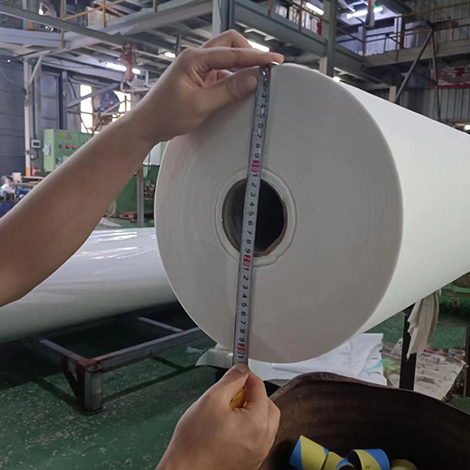

L'ajout d'un mélange-maître de carbonate de calcium lors de la production de non-tissés spunbond en PP (polypropylène) leur confère de nombreux avantages en termes de prix, de procédé de fabrication, de coût de production et de propriétés physiques. L'élargissement considérable des domaines d'application et le développement durable des non-tissés spunbond en PP, conjugués à la réduction de l'énergie et des émissions, constituent des tendances incontournables pour l'industrie des non-tissés spunbond. Aujourd'hui, nous vous présentons le procédé et les applications du carbonate de calcium dans les non-tissés.
Procédé de fabrication du carbonate de calcium dans un tissu non tissé spunbond en PP
La matière première utilisée pour la production de non-tissé spunbond en PP est du polypropylène à indice de fluidité élevé, mélangé uniformément à un masterbatch chargé de carbonate de calcium. Ce mélange est introduit dans l'extrudeuse à vis depuis la trémie pour la fusion par extrusion, puis passe par un préfiltre continu avant d'atteindre la boîte de filage. La matière fondue pénètre dans la tête de filage via une pompe doseuse, qui la dose précisément pour la transporter quantitativement vers le plateau de filage. Là, elle forme un flux continu et fin de matière fondue à travers les orifices de filage, constituant ainsi les fibres primaires. Ces fibres nouvellement formées sont refroidies par un courant d'air froid et étirées par ce même courant pour former de longs faisceaux. Ces faisceaux sont ensuite agités d'avant en arrière par le rouleau de filage et déposés uniformément sur le rideau de maille pour former une nappe de fibres.
Pourquoi choisir le carbonate de calcium comme mélange-maître de remplissage ?
Le carbonate de calcium est un produit chimique inorganique extrêmement important, largement utilisé dans des industries telles que les plastiques, le caoutchouc, les revêtements et la fabrication du papier. Voici les caractéristiques de plusieurs charges couramment utilisées dans l'industrie :
Carbonate de calcium : L’ajout de charge dans les non-tissés spunbond vise à réduire les coûts. Fort de son expérience dans la modification des propriétés des résines plastiques et la réduction des coûts, le carbonate de calcium est la solution la plus abordable et la plus facilement disponible. Il se présente sous forme de poudre blanche et inodore. Sa densité relative est de 2,71, son indice de réfraction de 1,65 et sa dureté Mohs de 3.
Terre ancienne : facile à disperser, relativement plus chère que le carbonate de calcium, également d'aspect blanc, avec une densité relative de 2,6 et un indice de réfraction de 1,56.
Poudre de talc : facile à disperser, elle lubrifie légèrement les équipements lors de la transformation et se présente sous forme de poudre blanche à cristaux solides. Je recherche une densité comprise entre 2,7 et 2,8, mais son prix est relativement élevé.
Poudre de mica : Sa blancheur relative est plus faible. De nature non toxique, la poudre de mica peut être utilisée dans les produits en contact avec les aliments. Sa densité relative se situe entre 2,8 et 3,0, son indice de réfraction est de 1,59 et sa dureté Mohs est de 3.
Wollastonite : avec une densité relative de 2,9, un indice de réfraction de 1,63 et une dureté Mohs de 4,5, son plus grand avantage est qu'elle n'absorbe pas l'humidité et a peu d'effet sur le mélange-maître de couleur.
Par conséquent, lors de la fabrication de tissus non tissés, le carbonate de calcium est généralement choisi comme charge principale, auquel on ajoute, de manière appropriée, une petite quantité de kaolin ou de wollastonite afin d'améliorer la dispersion et la transparence. On privilégie généralement un carbonate de calcium d'une granulométrie de 1500 mesh ou plus, car une granulométrie trop fine engendrerait un coût important. De plus, les poudres ultrafines sont généralement difficiles à disperser.
Méthode de remplissage du matériau de remplissage
Sans modifier l'équipement de production ni les conditions de traitement, la charge est ajoutée à la trémie d'alimentation du mélange-maître de couleur, mais le taux d'ajout s'en trouve limité. Certains fabricants installent une trémie et un doseur de plus grande capacité, spécifiquement dédiés à l'ajout de charges. La quantité maximale de granulés ajoutée est d'environ 20 %, et celle de poudre d'environ 8 %. D'autres fabricants ont ajouté une ou plusieurs machines de mélange pour homogénéiser ces matériaux avant de les introduire manuellement dans la trémie, ce qui permet une meilleure homogénéité. Le taux d'ajout peut alors atteindre 30 %, et la proportion de poudre environ 15 %. Enfin, certains fabricants mélangent le tout avant de l'aspirer dans la trémie, mais l'homogénéité est moindre, bien que la proportion de 20 à 30 % soit également possible.
Grâce à la réduction des coûts liés au remplissage, plus la concentration de l'agent de remplissage est élevée, plus le coût est faible et plus la part ajoutée par l'utilisateur est réduite. À l'inverse, plus la concentration est faible, plus le coût est élevé et plus la part ajoutée par l'utilisateur est importante. Par ailleurs, il est impératif de ne pas utiliser d'agent de remplissage dans le mélange maître fonctionnel de production afin de préserver ses propriétés.
Bien que l'utilisation de carbonate de calcium comme mélange-maître de charge puisse augmenter le rendement des tissus non tissés et réduire les coûts, les tissus non tissés produits par cette méthode présentent une faible résistance à la déchirure et sont très sensibles à l'usure. Pour pallier cet inconvénient,
Les précautions à prendre lors de l'utilisation du mélange-maître de remplissage sont les suivantes :
1. Il est impératif de ne pas mélanger un mélange-maître fonctionnel avec un mélange-maître de remplissage afin de préserver ses propriétés fonctionnelles. Les charges peuvent altérer l'action de certains agents fonctionnels, mais n'ont aucun effet sur la couleur.
2. Le mélange-maître de remplissage a un certain effet de dégradation, ce qui affecte la durée de vie des tissus non tissés, en particulier pour les tissus non tissés produits à partir de matériaux en poudre.
3. Les normes d'essai pour ce produit comprennent :
Norme GW∝-2000 pour le contrôle de l'incinération des déchets solides municipaux
Indice de fluidité à chaud GB 3682
Q/TNGM 01-2006 Méthode d'essai pour l'indice d'élévation de pression des mélanges-maîtres de couleur pour fibres de polypropylène
GB 1033 Méthode d'essai de la densité du mélange-maître de remplissage
Test de blancheur GB 2913
4. Le mélange-maître de remplissage se conserve mal à l'air libre pendant une longue période et son fort pouvoir absorbant l'humidité peut affecter sa filabilité. En cas d'utilisation irrégulière, le conditionnement sous vide est recommandé.

Soclal sharing


E-mail : marketing@henghuanonwoven.com
Ajouter : No.260 Liqi Road Hangcheng Street, Changle District, Fuzhou City, Fujian Province, China
Droit d'auteur
@ 2026 Fuzhou Heng Hua nouveau matériel Co., Ltd. Tous droits réservés
.  RÉSEAU PRIS EN CHARGE
laisser un message
Numériser vers Wechat :

Numériser vers WhatsApp :