Vous avez passé des mois :
Taille
Arrosage
Fertilisation
Surveiller la météo comme un faucon
Puis vient le jour de la récolte. Et vous découvrez :
picorements d'oiseaux
cicatrices de coups de soleil
piqûres d'insectes
Égratignures dues au frottement des branches dans le vent
Parfait à l'intérieur. Moche à l'extérieur.
Et les fruits moches = prix inférieur. Ou pire : refusés par l’acheteur du supermarché.
Sacs de protection pour fruits en polypropylène (PP) non tissé spunbond.
Elles ont l'air simples. Mais derrière ce tissu blanc et doux se cache une ingénierie agricole de pointe.
| Problème | Comment le polypropylène spunbond résout le problème |
| Insectes (mouches des fruits, papillons de nuit) | Barrière physique. Les insectes ne peuvent pas piquer ce qu'ils ne peuvent pas atteindre. |
| Coup de soleil | Diffuse les rayons UV nocifs. Colore les fruits uniformément sans les brûler. |
| Dégâts causés par les oiseaux | Assez robuste pour résister aux coups de bec. |
| Égratignures dues aux feuilles/branches | Sa surface intérieure douce ne risque pas d'abîmer les peaux délicates (pommes, poires, pêches, raisins, mangues). |
| Accumulation de champignons et d'humidité | Ça respire ! L'air circule, donc la condensation ne fait pas pourrir les fruits. |
Tous les sacs ne conviennent pas à tous les fruits. Voici comment choisir.
100 g/m² – Le polyvalent
Idéal pour : pommes, poires, pêches, mangues, goyaves, agrumes.
Pourquoi 100 g/m² ?Assez léger pour laisser passer 70 à 80 % de la lumière naturelle (ce qui permet aux fruits de prendre de magnifiques couleurs). Assez robuste pour résister au vent et à la pluie pendant 2 à 3 mois sur l'arbre.
Résistance à la traction: ≥ 120 N/5cm (ne se déchirera pas lorsque vous fermerez le sac).
respirabilité: 800-1200 mm/s (l'air circule librement — pas de moisissure).
150 g/m² – Le protecteur ultra-résistant
Idéal pour : Grenades, pomelos, grosses mangues, vergers d'altitude (UV intenses), ou des saisons de croissance plus longues.
Pourquoi 150 g/m² ?Tissu plus épais = meilleure protection UV + résistance mécanique accrue. À privilégier si le sac doit résister 4 à 6 mois sur l'arbre aux pluies de mousson et aux vents violents.
Résistance à la traction:≥ 220 N/5cm (presque indéchirable).
Respirabilité :600-1000 mm/s (toujours respirant, juste un débit d'air légèrement inférieur - convient aux fruits plus gros à la peau plus épaisse).
C'est ici que Les sacs en plastique bon marché échouent - et Le polypropylène non tissé liquéfié l'emporte.
Sacs en plastique (polyéthylène) agissent comme de mini-serres. Par une journée à 35 °C, l'intérieur d'un sac en plastique peut atteindre50°C+Cela cuit les fruits. Il en résulte des zones molles, des goûts désagréables et une maturation prématurée.
PP spunbondest différent. Parce que le tissu est poreux :
L'air chaud s'échappe
De l'air frais entre
Le fruit reste à l'intérieur2-3°C de la température extérieure
Résultat : Fruits mûris naturellement. Meilleure teneur en sucre. Durée de conservation prolongée après récolte.
| Fruit | Type de sac | Résultat |
| Mangues (Taïwan/Australie) | Spunbond 100 g/m² | Réduction de 90 % des dégâts causés par la mouche des fruits. Taux d'emballage supérieur de 30 % pour les produits destinés à l'exportation. |
| Pommes (Shandong/Europe) | Spunbond 100 g/m² | Un teint rouge parfait sans coup de soleil. Fini les piles de produits « rejetés » dans l'entrepôt d'emballage. |
| Grenades (Méditerranéennes) | Spunbond 150 g/m² | Aucun dégât causé par les oiseaux. Fissuration réduite de 50 % grâce à une humidité stable à l'intérieur du sac. |
| Raisins (raisins de table destinés à l'exportation) | 100 g/m² (rouleaux refendus sur mesure) | Des grappes propres. Aucun traitement chimique n'est nécessaire après l'ensachage. |
Étape 1 : Éclaircir les fruits
Ne conservez que les 1 ou 2 plus beaux fruits par grappe. Ne gaspillez pas de sacs pour des fruits que vous éclaircirez plus tard.
Étape 2 : Bien choisir le moment
Sac dans les 30 jours de la nouaison — avant que les insectes ne découvrent votre récolte.
Étape 3 : Emballer correctement
Placez le sac sur le fruit. Rassemblez l'ouverture autour de la tige. Fixez-le avec l'attache métallique intégrée ou une agrafe (ne pas écraser la tige).
Étape 4 : Laissez un petit espace
Ne le fermez pas hermétiquement. Une petite ouverture au fond permet à l'eau de s'écouler et à l'air de circuler.
Étape 5 : Retirer avant la récolte
Pour la plupart des fruits, retirez les sacs 1 à 2 semaines avant la cueillette. Cela permet le développement final de la couleur (surtout pour les pommes rouges et les pêches).
Si vous recherchez du non-tissé spunbond pour vos sacs à fruits, voici votre liste de contrôle qualité :
✅PP vierge(Les matériaux recyclés se dégradent plus rapidement sous l'effet des UV — ils ne conviennent pas pour une utilisation de 3 mois dans un verger.)
✅stabilisateurs UV(Demandez-nous — nous les ajoutons sur demande)
✅ Poids constant(100 g/m² ±5 / 150 g/m² ±7)
✅Pas de trous d'épingle(un minuscule trou = un point d'entrée pour un insecte)
✅bonne résistance aux larmes(Les producteurs serrent bien les sacs — le tissu fragile se déchire)
✅Respirant mais pas trop respirant (800-1200 mm/s pour la plupart des fruits)
Faisons le calcul.
| Sans sacs | Avec des sacs en polypropylène non tissé |
| 40 % des animaux ont été éliminés en raison de dommages causés par les insectes, de coups de soleil et de rayures. | 5 à 10 % éliminés |
| Vendu comme « qualité industrielle » à un prix inférieur | Vendu comme « qualité supérieure pour l'exportation » à un prix plus élevé |
| Coûts plus élevés des traitements chimiques (insecticides, fongicides) | Réduction des coûts de pulvérisation (les sacs font le travail) |
La plupart des producteurs amortissent le coût du sac dès les 2 ou 3 premiers arbres.
Vous pouvez pulvériser des produits chimiques. Vous pouvez recouvrir tout le verger d'un filet. Ou vous pouvez faire comme les producteurs avisés du monde entier :
Emballez les fruits. Protégez les profits.
Les sacs à fruits en polypropylène spunbond sont :
Réutilisable (certains producteurs rincent et Réutilisable pendant 2 à 3 saisons)
Biodégradable au fil du temps (le PP se décompose sous l'effet des UV, mais lentement).
Faible en main-d'œuvre (une personne peut ensacher 500 à 1000 fruits par jour)
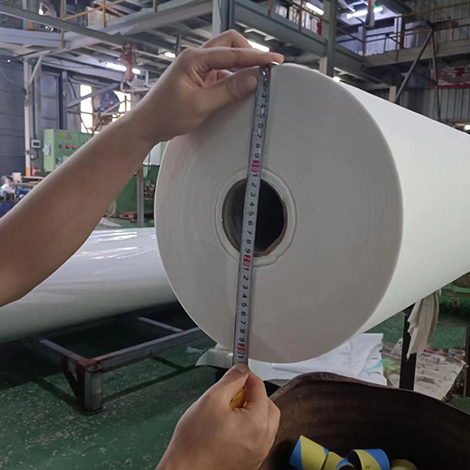
Nous ne fabriquons pas de sacs à fruits. Nous fabriquons le rouleau de tissu c'est ce qui rend les sacs de fruits possibles.
Nous sommes unfabricant de rouleaux de tissu non tissé spunbond— Fournir aux transformateurs, aux fabricants de sacs et aux distributeurs agricoles du monde entier du tissu PP de haute qualité.
Ce que nous proposons :
| Spécification | Détails |
| Matériel | 100% polypropylène vierge (PP) |
| Processus | non-tissé spunbond |
| Poids | 100 g/m² / 150 g/m² (grammages personnalisés disponibles) |
| Largeur | Jusqu'à 2,5 mètres (découpé à la longueur souhaitée) |
| Couleur | Blanc (standard), également vert clair, jaune ou sur mesure |
| traitement UV | Disponible sur demande (pour une durée de vie prolongée sur le terrain) |
| Noyau de rouleau | diamètre intérieur de 3 pouces (76 mm) |
| Longueur du rouleau | Personnalisable |
Pourquoi s'approvisionner chez nous ?
Poids constant (±5 g/m² pour 100 g/m² / ±7 g/m² pour 150 g/m²)
haute résistance à la traction (≥100 N/5 cm pour 100 g/m² / ≥180 N/5 cm pour 150 g/m²)
Excellente respirabilité (800-1200 mm/s pour 100 g/m²)
Pas de trous d'épingle — protection barrière complète
Prix direct usine
Qui doit nous contacter ?
Transformateurs de sacs à fruits à la recherche d'un approvisionnement fiable en bobines
Distributeurs agricoles construisant leurs propres lignes de sacs
Des vergers et des coopératives achètent du tissu en gros pour fabriquer leurs propres sacs.
Contactez-nous pour recevoir des échantillons de rouleaux ou un devis. Indiquez-nous le poids, la largeur et la quantité souhaités. Nous vous aiderons à trouver le tissu idéal pour la protection de vos fruits.
NON TISSÉ HENGHUA

Soclal sharing


E-mail : marketing@henghuanonwoven.com
Ajouter : No.260 Liqi Road Hangcheng Street, Changle District, Fuzhou City, Fujian Province, China
Droit d'auteur
@ 2026 Fuzhou Heng Hua nouveau matériel Co., Ltd. Tous droits réservés
.  RÉSEAU PRIS EN CHARGE
laisser un message
Numériser vers Wechat :

Numériser vers WhatsApp :