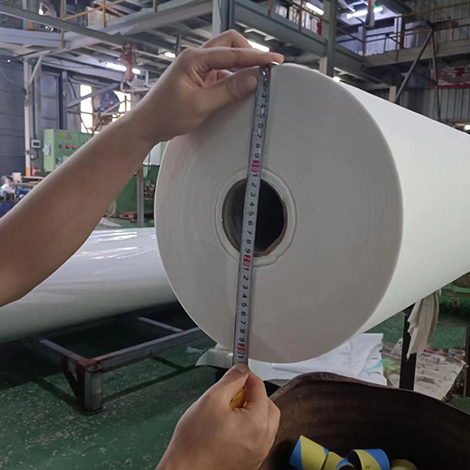

Du fabricant de rouleaux non tissés à vous
Vous êtes-vous déjà demandé comment un rouleau de tissu non tissé spunbond en polypropylène est-ce fait ?
Contrairement aux tissus tissés traditionnels (qui nécessitent de filer le fil puis de le tisser sur un métier à tisser), le non-tissé spunbond est produit dans un processus unique, continu et très efficace.
Passons en revue la chaîne de production étape par étape.
Tout commence par Résine de polypropylène (PP) 100 % vierge — de petites pastilles translucides qui ressemblent à de minuscules perles de plastique.
Ces granulés sont constitués du même matériau de base que celui utilisé dans de nombreux produits en plastique, mais pour les non-tissés, nous utilisons une qualité spécialisée avec un indice de fluidité à chaud (MFI) spécifique — généralement 25–40 g/10 min — ce qui assure une formation correcte des fibres.
Des additifs optionnels (stabilisateurs UV, retardateurs de flamme, pigments) sont mélangés à la résine à ce stade.
Les granulés de PP sont introduits dans un extrudeuse chaufféeÀ l'intérieur de l'extrudeuse, une vis rotative pousse les granulés vers l'avant à travers des zones chauffées — généralement 220 °C à 260 °C (428 °F à 500 °F).
Les granulés fondent pour former un liquide polymère épais, semblable à du miel.
Le polymère fondu passe à travers un système de filtration pour éliminer tout contaminant ou particule non fondue. Ensuite, un pompe doseuse contrôle avec précision le débit vers la filière, assurant ainsi un poids de tissu constant (GSM).
Le polymère fondu est forcé à travers un filière — une plaque métallique comportant des centaines ou des milliers de minuscules trous (généralement de 0,3 à 0,6 mm de diamètre).
Lorsque le polymère sort de la filière, il se forme filaments liquides continus. Immédiatement, de l'air à grande vitesse (air de refroidissement) est soufflé sur les filaments pour les refroidir et les faire passer de l'état liquide à l'état solide.
Il s'agit de la partie « filée » de spunbond.
Après refroidissement, les filaments solides passent à travers un buse d'aspiration d'air à grande vitesseCela étire les filaments jusqu'à plusieurs fois leur longueur initiale, ce qui :
Les filaments étirés sont ensuite déposés sur un tapis roulant en mouvement (appelé fil de formage). Un système de vide situé sous la courroie tire les filaments vers le bas, créant ainsi un toile uniforme et disposée aléatoirement.
Cette orientation aléatoire est ce qui donne au spunbond ses caractéristiques force uniforme dans toutes les directions — contrairement aux tissus tissés, qui se déchirent facilement dans le sens du tissage.
La toile aléatoire n'a pas encore de résistance — les filaments reposent simplement les uns sur les autres. Maintenant, ils doivent se solidifier. lié.
Le web passe par un calandre (rouleaux chauffants) — généralement deux rouleaux :
Chaleur et pression (environ 150°C–170°C) faire fondre partiellement les filaments aux points de contact, les fusionnant ainsi ensemble. Le résultat : un tissu solide et cohésif.
Il s'agit de la partie « liaison » du spunbond.
Selon l'application, le tissu peut recevoir traitements de surface:
Le tissu fini passe à travers découpe des bords (pour garantir des bords nets et droits), puis enroulé sur de grands mandrins en carton — généralement diamètre intérieur de 3 ou 6 pouces.
La largeur des rouleaux varie généralement de 1,6 m à 3,2 mCela dépend de la ligne de production. La longueur des rouleaux varie selon le grammage et les exigences du client.
Avant l'expédition, chaque rouleau subit tests de qualité:
Les rouleaux en transit sont emballés dans du plastique protecteur, étiquetés et préparés pour l'expédition.
| Scène | Équipement | Sortir |
|---|---|---|
| 1. Matières premières | Trémie / Silo à résine | Granulés de PP + additifs |
| 2. Extrusion | Extrudeuse monovis | Polymère fondu |
| 3. Filage | Filière + tremper l'air | filaments continus solides |
| 4. Dessin | Buse à air à haute vitesse | Filaments orientés et étirés |
| 5. Formation de la toile | Courroie de formage + vide | Toile de filaments disposée aléatoirement |
| 6. Lien | Rouleaux de calandre chauffants | tissu non tissé collé |
| 7. Enroulement | Enrouleur / refendeur | Rouleaux finis |
| Avantage | Pourquoi c'est important |
|---|---|
| Vitesse de production élevée | Jusqu'à 600 m/min — beaucoup plus rapide que le tissage |
| filament continu | Pas de peluches, pas d'effilochage, pas de points faibles dus aux fibres courtes |
| Processus en une seule étape | De la résine au tissu en quelques minutes — faible consommation d'énergie, faible main-d'œuvre |
| Propriétés uniformes | Grammage et résistance constants sur toute la longueur du rouleau |
| Recyclable | 100 % PP — peut être recyclé en nouveaux produits |
| Processus | Type de fibre | Force typique | Applications courantes |
|---|---|---|---|
| Spunbond | filament continu | Haut | médical, agriculture, emballage, géotextiles |
| Meltblown | microfibre | Faible | Filtration, couche intermédiaire du masque |
| Cardé (fibre discontinue) | fibres courtes | Moyen | Doublures, lingettes, isolation |
Le procédé spunbond est élégante dans sa simplicité — Fusionner, filer, poser, coller, enrouler. De la résine brute au tissu fini, en une seule étape continue.
Pas de tissage. Pas de tricot. Pas de couture. Juste tissu haute résistance, uniforme et économique produit à l'échelle industrielle.
C’est pourquoi le non-tissé spunbond est devenu le matériau de prédilection pour des milliards de produits jetables et durables dans le monde entier.
Vous recherchez un fournisseur fiable de rouleaux de non-tissé spunbond en PP ? Nous fabriquons des toiles spunbond monocouches de 10 g/m² à 150 g/m², avec des largeurs et des couleurs personnalisées disponibles.
Contactez-nous pour obtenir des échantillons ou un devis – Parlons de vos besoins en matière de non-tissés.

Soclal sharing


E-mail : marketing@henghuanonwoven.com
Ajouter : No.260 Liqi Road Hangcheng Street, Changle District, Fuzhou City, Fujian Province, China
Droit d'auteur
@ 2026 Fuzhou Heng Hua nouveau matériel Co., Ltd. Tous droits réservés
.  RÉSEAU PRIS EN CHARGE
laisser un message
Numériser vers Wechat :

Numériser vers WhatsApp :